

Knocking at Europe's door yet on the threshold of Asia,
Turkey is truly a land of contrasts. Here you can scale
the icy heights of remote Mount Ararat in search of
Noah's Ark, cross the historic Euphrates and Tigris
rivers, follow in the footsteps of St Paul or simply
relax on the golden Mediterranean sands of Patara beach.
Vibrant Istanbul, straddling the blue waters of the
Bosphorus separating Europe from Asia, beckons with
chaotic bazaars, imperial palaces and a history redolent
with harem intrigues.
With a remarkable tolerance of other customs, the Turks
offer a warm welcome wherever you travel. In Turkey, you
can also cruise along more than a thousand kilometers of
Mediterranean coastline, past secluded coves, rocky
headlands and pretty fishing villages, or explore a
hinterland rich in the wonderfully preserved remains of
Graeco-Roman cities such as
Ephesus. For
the adventurous, the austere beauty of the Anatolian
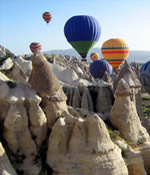
plateau, the surreal rock-chimney landscape of
Cappadocia and the atmospheric ruins of the enigmatic
Hittites await discovery.
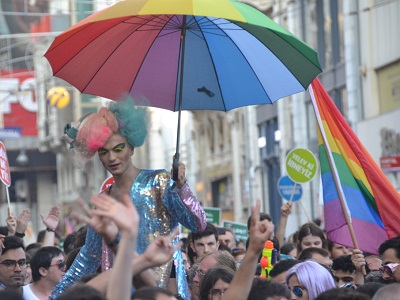
Understanding Turkish Gay Culture
Being situated at the intersection of
Europe and Asia geographically, Turkey was influenced by
both the Eastern and the Western civilizations. Turkey
is a fairly secular country and homosexuality has not
been illegal since the republic was founded in 1923.
There has not been a significant pressure on
homosexuality during the Ottoman Empire period also.
This makes Turkish gay life unique in the world. This
unique gay culture might be favorable or aversive
depending on expectations, but one thing is for sure: It
is very vivacious and very colorful. The gay culture of
Turkey, especially Istanbul, has become much more
Europeanized since the early 1990's.
Development of Turkish Gay Life in Recent Years
Generations in Turkey grew up with the fabulous voice
and hundreds of compositions of the classical Turkish
music performer
Zeki Muren, who was brave enough to sing with
a man's body in women's clothes and make-up in 1950's
Turkey. Turkish people called their first golden record
awarded artist "The sun of Art', never openly referring
to him as ‘gay' but rather as "extraordinary artist” and
respected and welcomed him just as Liberace was treated
in the USA during similar years. Muren was not the only
one with different sexual tendencies and was followed by
Bulent Ersoy, whose approved talent in the
music industry competed with her transsexual identity
from time to time.Bulent Ersoy had her gender-affirming
surgery in London in 1981, when she was already at the
peak of her career as a “male singer”.
Despite these ‘extraordinary' public figures, sexual
tendencies continued to be lived behind the walls until
the development of Turkey's own gay-lesbian-transgender
movement in early 80's. LGBTQ movement in Turkey
accelerated by the 1990s. Today, it has reached to a
level that gay and lesbian university students can apply
for an official student club. Although Turkey's LGBT
activists generally emphasize that it is the patriarchal
system behind sexual discrimination, which is found
worldwide, they mainly acknowledge that Turkey stands at
the beginning of the road to gain LGBT rights, with a
need to fight more strongly against sexual
discrimination than their counterparts in the West
Turkish LGBT organizations.
At the beginning of the 1990s, two local LGBT
organizations were founded:
Lambda Istanbul in Istanbul
in 1993 and
Kaos GL in the capital, Ankara in 1994. From
the beginning, these organizations worked to effect
changes not only in their immediate social environments
by organizing activities, publishing manifestos and LGBT
related information, but also in society at large
through their interactions with lawmakers and experts
from various fields.
Lambda Istanbul first came together
to organize the Gays Pride Week in Turkey in 1993. Not
giving up, the volunteers continued to meet for 9 years
and became officially registered last year. The aim of
Lambda Istanbul is to provide more visibility for LGBTs.
“You are neither alone, nor wrong,” is the slogan of the
organization.
Kaos GL, one among several LGBT organizations in Turkey,
publicized its struggle against homophobia in 1994 with
Turkey's first and only gay-lesbian magazine Kaos GL.
The organization stands out with its legal struggle for
LGBT rights. From opposing sexually discriminating court
decisions to proposing to add ‘discrimination of sexual
tendency' next to ‘gender discrimination' in the
criminal code, Kaos GL struggles
to prevent hate crimes against LGBT people. Starting its life through a photocopy machine,
Kaos GL
magazine has continued to survive since then as a
ground for Turkey's LGBT's to say their own words.
“Those 16 pages, copied in a photocopy machine will be
remembered as a turning point in the lives of those
women and men, who will take a shelter under the love of
their own gender and stand with this love even a hundred
years later,” current columnist in daily Radikal
Yıldırım Turker wrote about Kaos GL magazine in the 66th
issue of the magazine Express in 1995.
After mid 2000's several other local gay,
lesbian and transgender organizations and groups emerged
in Turkey such as
Siyah Pembe Ucgen in Izmir which was
formed by local LGBT community in Izmir and
Pembe Hayat
(Pink Life) in Ankara which is specifically fighting for
transvestite and transsexual rights. In Istanbul
another LGBT group was formed by people separated from
Lambda in 2007 and named themselves Istanbul LGBTI,
which closed several years later. In
2011 a new LGBT organization called
SpoD
was founded in Istanbul. After 2010 many new LGBT
groups and organizations were formed in comparatively
smaller cities. Many LGBT student groups were also
established in major Turkish universities, some of which
were even officially recognized by the university
administrations. As of 2020 there are more than two
dozen LGBT solidarity groups in Turkey. These are the most active LGBT
organization in Turkey at the moment
 Kaosgl.Org
- Ankara
Kaosgl.Org
- Ankara
PembeHayat.org - Ankara
17mayis.org - Ankara
SPoD -
Istanbul
Lambda Istanbul
- Istanbul
Hevilgbti.org -
Diyarbakir / Istanbul
Genclgbti.org - Izmir
Listag.org - Turkey (LGBT+
families)
Turkish Transgender Movement
Transsexuals and transvestites feel the oppression much
more than gays, lesbians and bisexuals mainly because they are
more visible. The struggle of transvestites and
transsexuals focusing on legal issues and the right to
work is now a main concern. The oppression from
society is overwhelming according to LGBT activists.
Pembe Hayat in Ankara focuses on transgender
issues more than other LGBT associations.
Turkish Lesbians
Gender roles make things more complicated for lesbians.
Women are already regarded as pretty much nonexistent,
but it is a double discrimination for lesbians. Gay
women have different problems and they took the back
seat in the LGBT struggle in comparison to male gays.
The pervasive prejudice within the society puts lesbians
under a great deal of pressure. It is very difficult for
most lesbians to ‘come out’ to their family and friends.
Each lesbian has to find her own way, without the help
of a visible lesbian community or any sort of support
organizations. Forced marriages are very common in rural
areas. Lesbians had a difficult time connecting with
other lesbian women until the internet became
widespread.. The Sisters of Venus, the first lesbian
group in Turkey, began meeting in July 1994.
Queer Visibility in Mass Media

Despite considerable change after the internet era, Turkish conservative family
structure in small cities and towns still discourage non-heterosexual
orientations. As for civic and legal positioning of homosexuality, there is no
statute that condemns or outlaws it. However, parallel to social denial and/or
condemnation of homosexuality there are no anti-discriminatory laws that protect
the rights of LGBT people. In addition, being an out LGBT individual is viewed
as adequate grounds for dismissal from the Turkish army and other civic service,
and the local law enforcement officials have also been known to be slow or
completely inept in handling violations of LGBT rights and gay bashings.
An average, typical Turkish family's first encounter
with queerness is usually through Turkish mass media.
Media coverage of queerness usually takes two forms.
Ordinary LGBT people, mainly transgenders appear on the
news with
sensational and derogatory headlines. Ironically Turkish
media is very liberal when it comes to famous LGBT
figures and entertainment shows on national Televisions feature
many queer celebrities and entertainers.
The very famous celebrities in Turkey appearing on TV
screens such as transsexual singer Bulent Ersoy,
drag-queen
Huysuz Virjin (Seyfi Dursunolglu), other queer
entertainment singers
Fatih Urek and
Aydin who all had their own TV shows, besides numerous
gay male entertainers working in chic nightclubs in
bigger cities who also appear on TV programs and they
are welcomed by the majority of the general population.
You can see a list of most famous Turkish LGBTQ figures
on this blog page
Pop Idols/Gay Icons
As everywhere there are several pop singers in Turkey
who are especially admired by the Turkish gay community.
Male singer
Tarkan has been the most popular pop
icon among Turkish gay men as much as straight teenage girls
since the 1990's, who is also partially popular internationally.
Ajda Pekkan, famous with her esthetic operations,
has been among the gay-icons in Turkey for decades.
Although they have no direct political discourse, her
songs have been symbols of the modern face of Turkey and
the freedom of women.
Hande Yener is the pop star of the 2000's,
who was once elected as the gay-icon on a poll organized by
Turkish gay magazine KAOS GL. Although she is not a gay
woman, she performed concerts in gay clubs in Istanbul
and finally joined the Istanbul Gay Pride in 2009,
being the first of such popular figures publicly
supporting gay and lesbian rights in Turkey. Other
singers who are popular among Turkish LGBT community are
Goksel,
Mabel Matiz and
Gulsen
Queer Art in Turkey

Plays by international and Turkish playwrights are
frequently staged in Istanbul, many in smaller venues
off Istiklal Caddesi, while the more commercial
extravaganzas (such as during the Istanbul International
Theatre Festival usually held in May) sometimes with digital
subtitling in English. Although it is not outspoken,
there are many gay actors known by the gay community in
Turkish theater. There have been a variety of plays about
or containing homosexuality in Turkish theaters. The
most well known of these is Cilginlar Kulubu by Ali Poyrazoglu's theater group, which is actually a Turkish
adaptation of
La Cage aux Folles (Bird Cage), a 1973
French farce by Jean Poiret.
In the last 30 years several Turkish movies with gay &
lesbian concepts have been produced and shown in movie
theaters. In the 1990's the most popular movie for the Turkish gay community was
Bagno Turco (aka Hamam
/ Steam)
Although it is an Italian production, the director and
majority of the cast are Turkish. In 2011 the movie
called
Zenne / Dancer became the Brokeback Mountain of Turkey, by winning
the best film prize in the most reputable film festival of Turkey- Golden Orange
Antalya Film Festival.
Foreign films, mostly from Hollywood, are generally shown in their
original language with Turkish subtitles. Mega cinema complexes are found
at most shopping malls in the outer suburbs. Beyoglu
cinemas also participate in the
Istanbul International Film
Festival, which mostly screen international
art-house movies, among which
there would be a number of gay and lesbian films almost every
year. The film festival is a popular event for the Turkish
gay and lesbian community for this reason.
Many books and novels about homosexuality have been
published in Turkish, including translations from
the International publishing market. Majority of the local products are
documentaries or research books. The serial books of
Mehmet Murat Somer have been the best sellers
in the short-novel category. In these serials the main
character (also the story-teller) is a transvestite
whose hobby is to solve murders in his/her neighborhood,
although he/she is just a manager of a trans-club. The
hero is an efficient hacker and most of the time she
uses her computer knowledge to find the murderers. For
an unknown reason the books of Mr. Somer have been less
welcomed by the local gay community, than the general
public. Some of Mehmet Somer's books have been
translated into English by Serpent's Tail, a British
independent publishing firm founded in 1986 by Pete
Ayrton, for those who are interested.
In 2012, famous female novelist Ayse Kulin published a
novel about the difficult life of a gay man growing up
in a closet in a very conservative neighborhood. The
book's title is Gizli Anlarin Yocusu ( G.A.Y, if
abbreviated) which can be translated into English as
"the traveler of secret moments' '. She expressed deep
sorrow after the political gay group, Lambda Istanbul
gave her local homophobia prize the same year for
writing about a subject she was not very familiar with,
and causing homophobia even if unintentionally. Despite
that she published another novel as the continuation of
that book, later in the year.
Murathan Mungan is the most outspoken gay Turkish poet &
writer, and he is well respected in the literature world of
Turkey. Many of his poems have been adopted as song
lyrics, which are well-known all over Turkey.
Click here
for a great Turkish song from Yeni Turku, with lyrics by
Murathan Mungan. Yet another out-of-closet gay Turkish
poet as famous as Mungan is rather known by his nickname Kucuk Iskender (means Alexander the Little).
Iskender is known for using explicit expressions of
eroticism and profanity in his poetry.
French novelist
Pierre Loti spent many years in Istanbul in
the late
19th century. He was known as a strong supporter of
Turks although he has also been criticized as being an Orientalist by prominent figures of Turkish literature,
including
Nazim Hikmet . Pierre Loti is said to be
involved in homosexual relationships and his novel
Aziyade
is claimed to be inspired from his love for a
local man.
HIV Statistics
The official numbers of HIV + people in Turkey is still
stated to be just a few thousands, Istanbul being the
leading city, naturally. A total of 39.437 HIV positive and 2295 AIDS cases have
been detected between 1985 and November 2023 in the whole of the country
according to the statistics of the
Ministry of Health; and homosexual and bisexual individuals hold a small
percentage (%13,24) of these official numbers. However,
the real number could be much higher than this because the majority of Turkish
society is still conservative about certain things and HIV is still regarded as
a sexual disease. Less-educated part of the population are not very
knowledgeable and attentive about safe sex. Consequently the people either do
not take any HIV tests or tend to hide themselves, and it is not very possible
to obtain accurate numbers.
Law and regulations
Turkey is a constitutionally secular country and there
is not any law against homosexuality since it was
founded in 1923. Even though sexual orientation is not
being mentioned specifically, an anti discrimination law
(5237/122) enacted by the parliament in early 2000's can
also be used by Turkish LGBT people to protect their
rights. The first significant implementation of this law
was in 2015 against a bath house owner who refused to
offer service to a Turkish transgender woman. Also in 2016 an openly gay
Turkish referee
won a landmark lawsuit against the Turkish Football
Federation following his dismissal in 2009. Since the
beginning of 2010's two of the major
opposition parties have been openly supporting LGBT
rights and they have even presented few
LGBT candidates in local and general
elections.
The age of consent is 18, which also applies as the age
limit to be able to enter bars and clubs selling
alcohol. Regardless of the sexual orientation, any
sexual activity with someone below the age of consent
is regarded as pedophilia and it is illegal even if it
is done with the approval of the minor partner.
LGBT in Politics.
Although several small liberal and leftist parties have
been supporting LGBT rights since the early 2000's LGBT
people have been ignored by the big political parties
holding seats in the Turkish parliament until 2010's. Since early
2010's both secularist and social democrat main
opposition party
CHP (Republican People's Party) and pro-Kurdish,
democratic socialist
HDP publicly supported LGBT rights and they
nominated few LGBT candidates in 2014 local election and
2015 general elections. The total votes of these
two political parties approaching to % 40's in June 2015
parliamentary elections can be considered as a sign of
increasing acceptance of the LGBT people by Turkish
society.
Turkish People

Turkish people have very diverse appearances, ranging from Caucasian (white) to
Mediterranean features. Many of them have fair skin, but you can also find
brunettes and blondes with different eye colors. Moreover, Turkey is one of the
most popular tourist destinations in the world, attracting more than 40 million
visitors every year from various nationalities. A considerable number of expats
from different western countries live in Istanbul and other large cities for
work or other purposes. You can see some examples of the ethnic diversity in
Turkey by looking at this picture gallery of
famous Turkish male celebrities.
References
http://www.bgsu.edu
http://www.iglhrc.org
Turkishdailynews.com.tr (April 9, 2007- Safak Timur –
Turkish Daily News)
 Click here to make additions, improvements and corrections.
Click
here for a full list of gay friendly hotels
in Istanbul.

You can make Instant reservation via
online & secure affiliate system and help us
maintain our websites without any extra cost
on your side
 Instant & secure hotel reservation.
Free cancellation
option is available!
No commission
to be
charged by us
 The reservation, payment and cancellation
procedure of hotels will be handled via Expedia / Hotels Com.
The reservation, payment and cancellation
procedure of hotels will be handled via Expedia / Hotels Com.
Staying in a short-term rental apartment would be the
best alternative to hotels for LGBTQ people who
prioritize privacy. We offer reservations via the
reputable vacation rental website
Vrbo, an affiliate of
Expedia which
also owns Hotels.Com

Book on Vrbo.Com (No commission &
Free cancel option)
|
|

Instant & secure reservation for gay and lesbian friendly hotels in Istanbul
Read More